Showing posts with label Brian Cashman. Show all posts

Thursday, January 28, 2010

Feeling Randy Baby-- Yankees Put Randy Winn in Pinstripes


After acquiring outfield prospect Greg Golson from the Texas Rangers earlier in the week, the Yankees signed former Giants left fielder, Randy Winn, to a one year deal worth at least two million dollars.

The switch-hitting Winn who turns 36-years-old in June, has a career .286 batting average and 209 stolen bases throughout his 12 seasons in the MLB. Although Winn is coming off one of the worst years of his career--batting .262 with just two home runs and posting a disappointing .671 OPS over 538 at bats-- the Yankees found his impressive and underrated defense in the outfield corners, where he has contended for a gold glove annually, as a justifiable reason to give him a deal. While Winn fits best in left field, where he will sport one of the best gloves in the American League, he is also capable of playing plus defense in right and even playing slightly-above-average defense in center.

His relatively cheap contract, positive clubhouse presence, professional bat and plus defense make signing Winn for a year a low-risk/relatively-nice-reward-deal. What's puzzling however is the glut of outfielders that can't hit lefties that the Yankees are now left with. While Winn has actually hit lefties at a decent clip throughout his career (.280 batting average, .758 OPS) he batted just .158 and posted an abominable .384 OPS against them in 2009. Curtis Granderson has posted a .614 OPS against lefties throughout his career, while Brett Gardner has posted a .627 OPS against southpaws in his. Gardner, however, improved his pitch recognition to the point where he actually hit southpaws slightly better than right-handers in 2009.

Signing Randy Winn would make sense, however, if GM Brian Cashman does indeed close the deal on Rocco Baldelli. While Baldelli, a former super-prospect, does have a debilitating illness--channelopathy-- that has robbed him of the ability to start everyday, he does provide a cheap, lefty-mashing bat. The 28-year-old outfielder has a career .495 slugging percentage and has an .831 OPS against lefties. Outside of his 2007 season, Rocco has never had an OPS below .786 when batting against lefty pitchers. Baldelli also has a strong, accurate arm, has plus baserunning instincts and speed, and can play all three outfield positions better than the average MLB outfielder.

Currently, Cashman seems content on the minor league deal he offered to Baldelli earlier in January. Signing the Rhode Island native to a minor league contract would allow the Yankees to keep Rule-5 Draft pick, outfielder Jamie Hoffman, on the roster until he proves either worthy or ineffective. If Hoffman does struggle, he could be stashed on the disabled list--something the Nationals and many other teams are notorious for doing with their Rule-5 picks-- after the first few weeks of the season, allowing Rocco the chance to claim his spot with the big club by June. If Hoffman refuses to be stashed on the DL, the Yankees could either give him more time or attempt to return him to the Nationals. Frankly, if the Yankees have to pay a small some of money to the Dodgers for returning Hoffman, they would still net a benefit from the Bruney-for-Hoffman trade by avoiding the expensive arbitration sum that a marginally useful Bruney would have commanded.

If the Yankees don't end up signing Rocco Baldelli, it has been rumored on MLBTR.com, that Johnny Gomes could be Cashman's backup plan if he is willing to accept a minor league contract. Like Baldelli, Gomes is a former Devil Ray whom is particularly adept at hitting lefties. Unfortunately Gomes can do little else--offering a poor glove, high strikeout rates and no speed.

Gol Tending
: Yankees Acquire Outfielder Greg Golson from Rangers

Just days before signing Randy Winn for 2010, the Yankees sent a failed prosect-- former Purdue star Mitch Hilligoss-- and cash to the Texas Rangers for another failed prospect, Greg Golson. After signing a failed ballplayer, Khalil Greene, the Rangers designated Golson for assignment and immediately started listening for offers.

Golson, rated as the "Best Athlete" in the Rangers system prior to the 2009 season by Baseball America was actually somewhat of a steal for the Yanks. While he hasn't lived up to expectations (barely posting a .700 OPS in 2,558 official at bats in the minors and going hitless in a handful of MLB at bats) since being drafted 21st overall by the Phillies in 2004, the 24-year-old outfielder does possess 5 tool talent and plus-to-plus-plus speed. Even if Golson fails to hit for the average and power that he was projected to have five years into his professional career, he still possesses a strong arm, plus outfield range and the ability to be a valuable pinch runner. While Brett Gardner seems to be well entrenched in the Yankees plans for 2010, using his top-shelf speed, strong arm, and adequate (yet somewhat soft) bat to secure about a half-season worth of playing time as defensive/stolen base specialist, Golson is a somewhat comparable option whom could be a nice insurance policy if Granderson, Gardner or Winn land on the DL. Before posting a forgettable 2009 at AAA Oklahoma within the Rangers organization, Golson had batted .282 with 13 bombs, 23 stolen bases in 2008, and had received praise for his small improvements on his sometimes spectacular/sometimes sloppy defense in center field.

Women May Work from Sun to Sun but a G.M.'s Work is Never...


Now that the Yankees' outfield is somewhat more stable than what it was coming in to the 2010 offseason, GM Brian Cashman will continue to wait for a few remaining players to fall in to his price range. With Baldelli somewhat close to signing, the acquisition of veteran backstop Mike Rivera, and the loss of Jerry Hairston Jr. to the Padres, Cashman will surely turn his attention to an infielder/utilityman who could compete for a spot on the bench this Spring. While Ramiro Pena is a nice fielder, capable of playing plus defense up the middle and playing a solid third base, his hitting leaves a lot to be desired. Free agents, Felipe Lopez and Orlando Hudson are both likely looking elsewhere for a starting job and/or more money than the Yankees can currently offer, however. Free agent Adam Kennedy wouldn't be enough of an improvement over Pena, and Orlando Cabrera is probably too expensive. Lefty Noah Lowry, coming off a two-year spat of thoracic outlet syndrome is worth a look for his bargain-level price tag and the Yankees' sparse supply of effective left-handed relievers. Marlins second baseman, Dan Uggla is still on the trading block and may be a good fit for the Yankees if he's willing to accept both a reduction in playing time and an increase in time at third base and (possibly) left field. Uggla's recent raise in salary would make him an expensive option as well. Frankly, Jerry Hairston Jr. was a very good fit for the Bombers, and unless Cashman can find someone comparable on the trade market, his loss will be felt in 2010.

Overall, signing Randy Winn, trading nothing of value for Greg Golson and offering Rocco Baldelli a reasonable contract have put the Yankees in a good spot for 2010. While their roster does have a few holes left in it, Brian Cashman has improved upon the 2009 team and has given the Steinbrenner's the flexibility to trade for a premium player this summer and/or to bid on Joe Mauer, Carl Crawford, Jason Werth, Cliff Lee, Josh Beckett, (possibly) Matt Cain, Mariano Rivera and (possibly) Aaron Harang next winter.

Tuesday, December 8, 2009

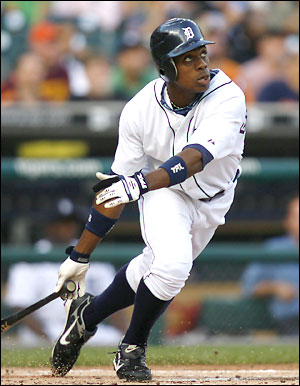
Grand Theft: Yankees Get Curtis Granderson from Tigers


Brian Cashman stunned the baseball world Monday night, when he revealed that he was en route to closing a deal with the Tigers and Diamondbacks that put Curtis Granderson in pinstripes. Immediately, every good Yankee fan, wraught with glee, took a moment catch their breathe. In that moment images of Joba Chamberlain, Phil Hughes and Jesus Montero in another uniform started to sour their excitement over the trade. But then, moments later, when each of those fans realized that Curtis Granderson would be donning pinstripes for the miniscule price of Ian Kennedy, Phil Coke, and Austin Jackson, their eager aniticipation for 2010 resumed.

After years of disappointment spurring from 200 million dollar payrolls worth of faded, broken, overpriced and arrogant stars like Kevin Brown, Gary Sheffield, Randy Johnson and Carl Pavano, the Yankees' front office has been determined to extend it's recent streak of good trades and signings. Transactions that netted them C.C. Sabathia, Mark Teixeira, A.J. Burnett, Nick Swisher and a shipment of shiny, new, diamond-studded 2009 World Series rings. This latest trade for Curtis Granderson, is an eager attempt at securing a shipment of 2010 World Series rings, and a vivid illustration of how good a General Manager Brian Cashman can be when given some breathing room.

Cashman has long been booed by Yankees fans and the baseball world for his insufferable attempts at exhausting the Yankees near-infinite revenue on overpriced, underachieving and often, downright dispicable players, in meager hopes of returning the franchise to the World Series. Now that the geriatric Steinbrenner has finally quieted down, and has allowed Cashman to use the franchises' money wisely, the Yankees are looking better than ever.

The winners of the three way trade: 1st Place, Yankees, 2nd place, Tigers, last place, Diamondbacks. The Yankees landed Granderson for a package of players that certainly won't be missed in New York. Trading Ian Kennedy for anything of value is sheer brilliance by the Yankees' Brass. Kennedy barely has the stuff to pitch in Beer League softball, much less the MLB. 85 mph fastballs, rolling curveballs in the dirt, and eye-level vulcan changeups should be a challenge for the Diamondbacks to use in a rotation that needs some stability--especially when half of Kennedy's games will be played in Arizona's unforgiving dry air. Kennedy's attitude won't be missed in the Yankees clubhouse either.

Trading Phil Coke is far more painful for the 2010 Yankees than trading Ian Kennedy, but that's not saying very much. Coke was a useful and durable arm for Girardi's bullpen in 2009, and his ability to get out good lefties certainly helped the Yankees toward the World Series. But Coke's lack of a sharp breaking ball, and his low ceiling make him expendable--even if he is a durable lefty and is a gamer.

Austin Jackson, arguably the Yankees top prospect (in my view he's far behind Jesus Montero) was the blue chip Detroit needed in return for Granderson. Although Jackson's baseball intellect is sub-par--striking out far too much, walking little and exercising average baserunning abilities despite top-flight speed-- he has the tools to win a Gold Glove in center, and could hit in the realm of .275-.280 with 15 homeruns and 20 stolen bases once he gets comfortable in the majors. Frankly, it's unlikely that he'll every be more than a decent everyday center fielder.

So, for very little, the Yankees netted a very good outfielder. King Curtis does have his shortcomings however. First of all, he's coming off a year where he hit .249, and his career batting average against lefties is barely .210. He plays good defense, but isn't fabulous, and will probably spend far more time in left than in center. Still, if the Yankees can land a lefty-mashing right-handed outfielder, or make use of Melky Cabrera, then they have a relatively cheap All-Star caliber outfielder under their control for at least three seasons. Granderson's power will transfer well to Yankee stadium, so netting an outfielder that will easily hit 25-30 homers annually is worthy of a pat-on-the-back for Brian Cashman.

Second Place

The Tigers did a decent job of dumping fairly pricey players for cheaper talent, with this trade. Max Scherzer is fragile, and may end up in the bullpen, but the Tigers will have control over Scherzer for a half-decade. Max has top-tier stuff, and if he can stay healthy, he could be a cheap AJ Burnett, or a lesser Jon Papelbon.

Dan Schlereth and Phil Coke are both useful lefties in the bullpen. Both pitchers throw hard, with Coke' average fastballs at about 92 mph, and Schlereth sporting the ability to hit 97-100 mph. Dan Schlereth, the son of former NFL meathead Mark Schlereth, could be a future closer if he can harness his control. Coke is durable, and if he can avoid the long ball in his now spacious homepark, facing AL Central opponents, he could be a top-tier lefty middle reliever and palatable spot starter.

Austin Jackson won't be a star, but he will be a cheap replacement for Granderson in center. Jackson's defensive potential is far beyond that of Granderson's, but his lesser power and lackluster approach at the plate keep the possibility of his future as a 4th outfielder open. If he reaches enough of his potential, Jackson could be a top fielder with a David DeJesus bat and Curtis Granderson speed.

The Loser

The Diamonbacks made some serious mistakes this offseason. First, they traded for Aaron Heilman, an overpriced choke artist with marginal value in the pen. Then, they traded away one of their most valuable pitching talents in Max Scherzer, for a pitcher that may be on the verge of busting. Scherzer had his drawbacks, true, but his stuff gave him the ability to be a top starter or top closer--even in Arizona. Scherzer could have gotten them much more in return, and now they lost a cheap, productive arm.

Edwin Jackson has shown flashes of brilliance with his 95-96 mph fastball, but his lack of control and polish got him catapulted out of Tampa Bay. He pitched well in Detroit for the first half of 2009, and was on the fast track to a Cy Young Award when he pulled a midseason 180 and started stinking up the mound. Pitching in Arizona, and calling a bandbox his new home park should send him right back to the stat lines he produced in Tampa.

Ian Kennedy, the other arm that Arizona received in return for Scherzer has previously been touted as a top pitching prospect on par with Phil Hughes and Joba Chamberlain. He's not. I tried my best to like Kennedy after his promising 2007 debut. After all, he had a nice Irish name, a USC Pedigree and scouting reports that made him sound like the second coming of Greg Maddux or Mike Mussina. Watching him for 2+ seasons has driven this point home though, Ian Kennedy stinks, and he won't be a decent MLB starter, much less a Hall of Famer. Scouting reports claiming that Kennedy threw 92 mph fastballs were bogus, and his one above average pitch is his vulcan change which he's going to need to live off of, if he wants to survive for a few more years in the majors. Kennedy's fastball is usually clocked in the 86-88 mph range, hitting 90mph just a little bit more often than it hits 85. He has good control of the pitch when he throws it at MiLB speed, but lousy control when he dials it up to a passable MLB velocity. It's also straight. Kennedy's curveball could be passable with work, but currently it doesn't have a sharp enough break to strike out the average MLB batter.

Kennedy's control had previously been touted as plus to plus-plus, but he hasn't lived up to this aspect of his scouting reports either. When using his AAA repetoire, he does have good control, but its far too hittable. His lack of stuff forces him to over throw and pitch around every batter he faces, resulting in high pitch counts and high WHIP numbers. Overall, Kennedy has an outside shot of becoming Denny Neagle with some serious development, but its is becoming more and more likely that he's nothing more than a fringe player.

So, overall, the Yankees made a fantastic trade, while the Tigers didn't realize anything spectacular from trading Granderson and Jackson, but manage to accomplish some of their mission for 2010. The Diamondbacks are the clearcut losers here, and likely gave up one of the few promising young players they have in exchange for a pitcher that is on the verge of becoming a serious bust.
Custom Search